
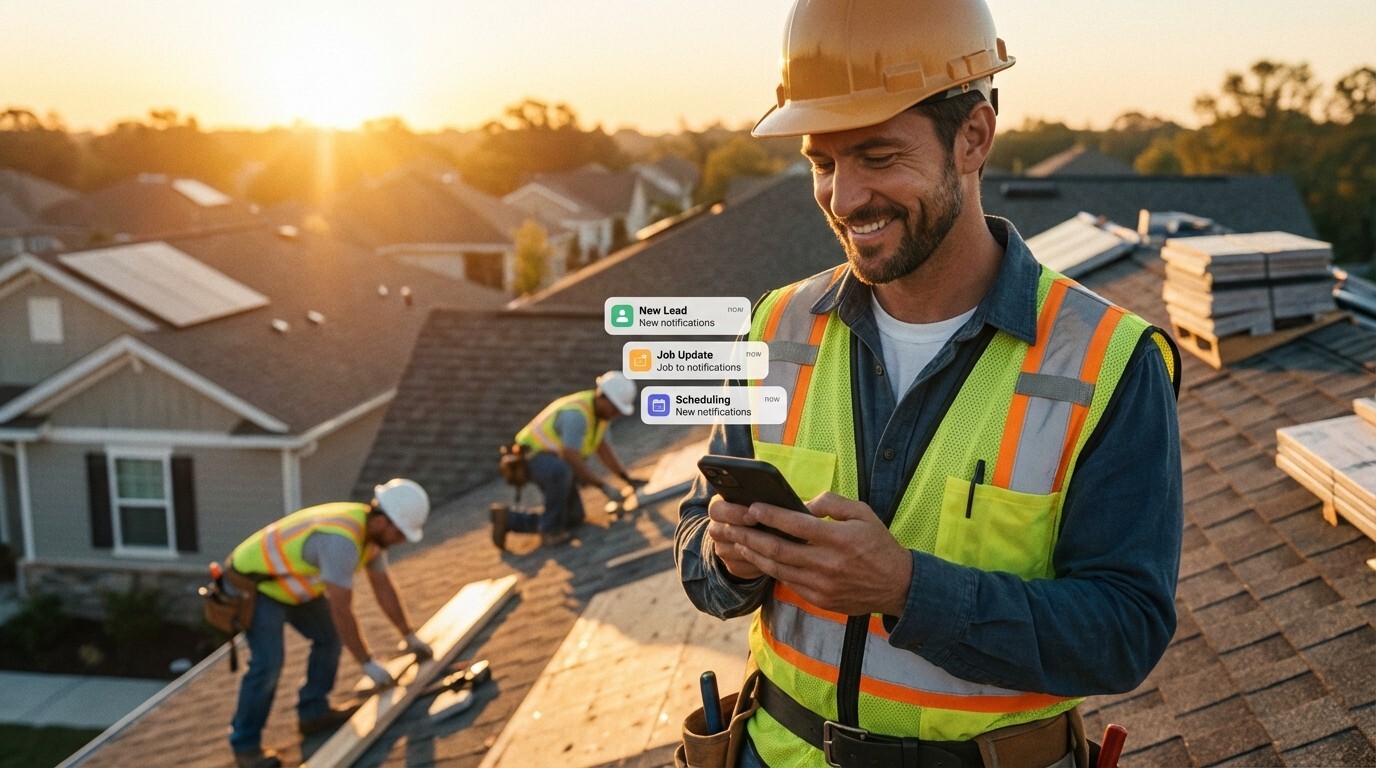
It’s 8:14 on a Tuesday night. A homeowner just found a leak in the ceiling. They Google “roofer near me,” click your ad, and fill out a form on your website.
You’re at dinner with your family. You don’t see the notification until 7am the next day.
By the time you call back, they already booked with the company that texted them back in 30 seconds.
That’s not a made-up story. That happens every single day in roofing, HVAC, plumbing, solar, and every other home service business. And it’s costing you a lot more than one job.
The Real Cost of Being Slow
Here’s what most contractors don’t realize. Speed is the new skill in home services.
Studies show that responding to a lead within 60 seconds makes you 391% more likely to convert that lead compared to waiting even 5 minutes. After 30 minutes? That lead is basically gone.
Think about that. You’re spending money on Google Ads, mailers, yard signs, referrals, and all kinds of marketing. The leads are coming in. But you’re losing them because nobody picks up the phone fast enough, nobody follows up, and nobody chases the estimate you sent three days ago.
It’s not a lead generation problem. It’s a lead management problem.
Why Most Home Service Businesses Lose Jobs
Let’s be honest. You already know why this happens.
You’re on a roof. You’re under a house. You’re driving to a job site. You’re doing payroll. You’re ordering materials. You’re dealing with a customer complaint.
Meanwhile:
- A new lead submitted a form and nobody responded
- A prospect called and it went to voicemail
- An estimate was sent last Thursday and nobody followed up
- An appointment was booked but the customer forgot and no-showed
- A job was completed two weeks ago and nobody asked for a review
- A happy customer would have referred you to their neighbor but nobody asked
None of this is because you don’t care. It’s because you’re doing 14 different jobs at once and follow-up always falls to the bottom of the list.
That’s where a system changes everything.
What a Real Contractor CRM Workflow Looks Like
When we say “system,” we don’t mean another app you’ll download, set up halfway, and forget about in two weeks. We’re talking about a complete workflow that runs in the background while you do your actual job.
Here’s how it works from start to finish.
1. Lead Capture — Every Lead Lands in One Place
Leads come from everywhere. Facebook ads. Google. Your website form. A text message. A chatbot on your site. A referral. A phone call.
The problem is that most contractors track these leads in their head, a notebook, sticky notes, or maybe a spreadsheet that hasn’t been updated since last month.
With the right contractor CRM automation, every lead from every source feeds into one system automatically. No more “I forgot to write that one down.” No more checking five different inboxes.
Every lead is captured. Every lead is tagged by source. Every lead gets assigned to the right person.
2. Speed to Lead — Your System Responds in Seconds
This is the part that wins jobs.
A homeowner fills out a form on your website at 8:12pm on a Saturday. Your system sends them a personalized text within 30 seconds. Something like:
“Hey [first name], thanks for reaching out to [your company]. We got your request and we’d love to help. Want to book a free estimate this week? Here’s a link to pick a time that works for you.”
That homeowner just went from “I hope someone calls me back” to booking an estimate on your calendar. While you were watching a movie with your kids.
That’s what HVAC lead follow-up should look like. That’s what roofing lead follow-up should look like. Fast. Automatic. Personal.
3. Missed Call Text Back — No More Lost Calls
You can’t answer every call. That’s just reality when you’re running a crew and doing the work yourself.
But here’s what happens without a system. The phone rings. You miss it. The prospect calls the next company on Google. You lost a $6,000 job because you were 40 feet up on a ladder.
With missed call text back, the moment a call goes unanswered, the system automatically texts that person:
“Hey, sorry we missed your call. We’re out on a job right now. Want us to text you a quote or book a time to talk?”
Now that lead stays warm instead of going cold. They know you’re a real company that’s actually busy doing work. That builds trust. And most of the time, they text back.
4. Appointment Automation — They Actually Show Up
Booking the appointment is only half the battle. The other half is making sure the customer actually shows up.
How many times have you driven 45 minutes to give a free estimate and the homeowner isn’t home? Or they forgot? Or they say “can we reschedule?”
The system handles this. It sends a confirmation right after booking. Then a reminder the day before. Then another one the morning of. And if they need to reschedule, they can do it themselves through a link. No phone tag required.
Your system reminds the customer so they actually show up to the estimate. You stop wasting gas and time driving to no-shows.
5. Sales Pipeline — Know Exactly Where Every Job Stands
Right now, if someone asked you “how many open estimates do you have out?” could you answer in under 10 seconds?
Most contractors can’t. They have to dig through emails, texts, and random notes to piece it together.
A CRM pipeline changes that. Every lead moves through clear stages:
- New Lead — just came in
- Contacted — first response sent
- Engaged — they replied or clicked
- Qualified — real opportunity, not a tire kicker
- Appointment Booked — estimate scheduled
- Estimate Sent — ball is in their court
- Negotiation — working out details
- Won or Lost — closed deal or not
You can see everything at a glance. You know which leads need attention. You know which estimates need a follow-up call. Nothing falls through the cracks because the system tracks it for you.
6. Follow-Up Automation — The Money Is in the Follow-Up
Here’s a stat that should bother you. 80% of sales require at least 5 follow-ups. But most contractors follow up once, maybe twice, and then move on.
The system doesn’t forget. If a lead doesn’t respond to your first text, it sends another one the next day. Then an email. Then a task pops up for your VA or salesperson to make a call.
It follows up through SMS, email, and phone tasks automatically. Multi-channel. Persistent. Professional.
Not pushy. Not spammy. Just consistent. Like the contractor who actually cares enough to follow through.
7. Job Fulfillment Pipeline — From Won Deal to Completed Job
Most CRMs stop at the sale. But the work doesn’t stop when the customer says yes. That’s when it starts.
Once a job is won, it moves into a delivery pipeline:
- Onboarding — collect documents, contracts, deposits
- Appointment Scheduled — work date confirmed
- In Progress — crew is on site
- Waiting on Client — need approval or materials
- Completed — job is done
- Review Requested — ask for the review
- Closed — wrapped up
Your team can see every job’s status. The customer gets updates. Nothing gets stuck in “waiting” mode because someone forgot.
8. Review and Referral System — Turn Happy Customers Into Growth
You just finished a beautiful roof install. The homeowner is thrilled. They tell you “great job” as you’re packing up the truck.
Three months later, they still haven’t left a review. And their neighbor who needed a new roof? They hired someone else because nobody asked for a referral.
The system fixes this automatically. As soon as the job is marked complete, it sends a friendly text asking for a Google review. A few days later, it asks if they know anyone else who might need help.
More five-star reviews without awkwardly asking in person. More referrals without remembering to follow up. This is how home service lead management works when it’s done right.
What This Means for Your Business
When you stack all of this together, here’s what actually changes:
- More booked estimates — because you respond in seconds instead of hours
- Fewer wasted leads — because nothing gets forgotten
- Higher closing rates — because your follow-up is consistent
- Less no-shows — because reminders go out automatically
- More Google reviews — because the system asks for you
- More referrals — because the system asks at the right time
- Less stress on you — because you stop being the bottleneck
You stop being the receptionist, the follow-up person, the appointment booker, and the review requester. You go back to being the business owner.
But Who Actually Runs This System?
This is the part most people miss. A CRM by itself doesn’t solve anything. You need someone to manage it.
That’s the problem with most contractor CRM tools. They sell you the software, give you a login, and leave you to figure it out. Three months later, the CRM is collecting dust and you’re back to sticky notes.
BoostOps takes a different approach. Instead of just giving you a tool, you get three things working together:
- A trained, full-time virtual assistant — a real person who manages your CRM, responds to leads, follows up, books appointments, and handles the admin work that’s eating your day
- AI assistance — smart automation that handles the speed-to-lead texting, missed call recovery, follow-up sequences, review requests, and more
- A complete CRM with all the automations built in — pipelines, workflows, calendars, forms, and reporting all set up and ready to go
You’re not buying software and hoping it works. You’re getting a full system with a real person running it.
And the cost? $11.86 per hour for a full-time assistant running the entire system. That’s less than what most contractors spend on lunch for the crew. And it pays for itself the first week when you stop losing leads.
Stop Losing Jobs to Faster Competitors
Here’s the truth. Your competition is not always better than you at the work. They’re just faster at responding.
The contractor who texts back first wins the job. The company that follows up five times gets the deal. The business that asks for reviews gets found on Google.
You already know how to do great work. What you need is a system that handles everything before and after the job so you can focus on the work itself.
If your business is missing calls, forgetting follow-ups, and losing jobs to faster competitors, this system fixes that.
👉 See how the workflow works or book a quick call at BoostOps.org